Click the button below and we will turn this article into a plan for your business, with numbers, on a free 15-minute call.
Book a Free Strategy Session(Free 15-minute session with the Twiz team)Written by
Published
November 9, 2026
Reviewed by
Read time
8
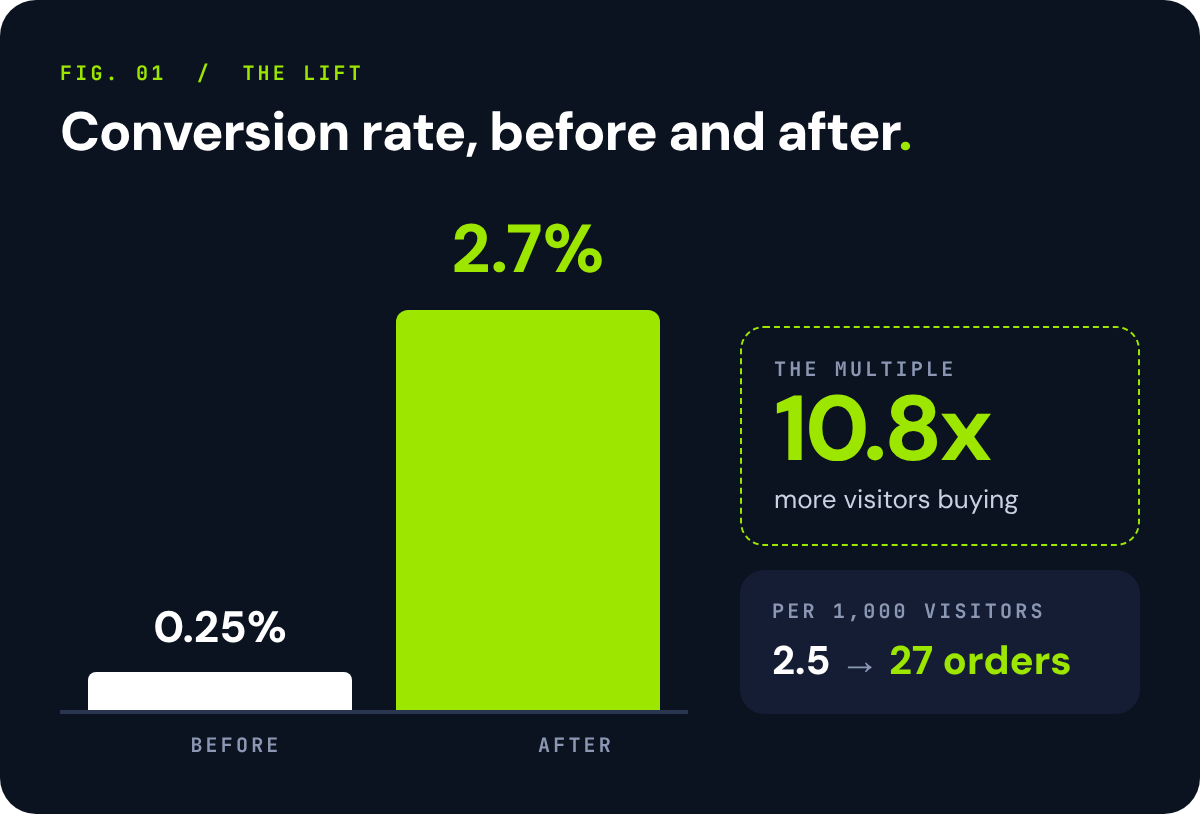
To improve your ecommerce conversion rate, fix five things in order: put your offer and proof above the fold, write copy that speaks to the customer, give visitors who are not ready to buy a reason to leave their email, follow up by email every day, and remarket to that list. These are the exact steps we used to take 123 Baby Box from a 0.25% conversion rate to 2.7%.
This guide covers what a good ecommerce conversion rate looks like, how to calculate yours, and each of the five steps with the real numbers behind them.
Ecommerce conversion rate is the percentage of store visits that end in an order. The formula is simple:
Conversion rate = orders ÷ sessions × 100
If your store gets 1,000 sessions and 27 orders, your conversion rate is 2.7%. It is the single number that decides how far your ad budget goes, because every visitor you pay for either buys or does not.
Published benchmarks vary by dataset. Dynamic Yield's global ecommerce benchmark sits at about 2.7%, while Littledata's benchmark puts the average Shopify store at 1.4%, with the top 20% of stores above 3.2%. Most sources land in a range of roughly 1.4% to 3%.
The more useful comparison is your own store last quarter. 123 Baby Box started at 0.25%, far below any benchmark. That meant one buyer for every 400 visitors, and no ad account can scale on that math.
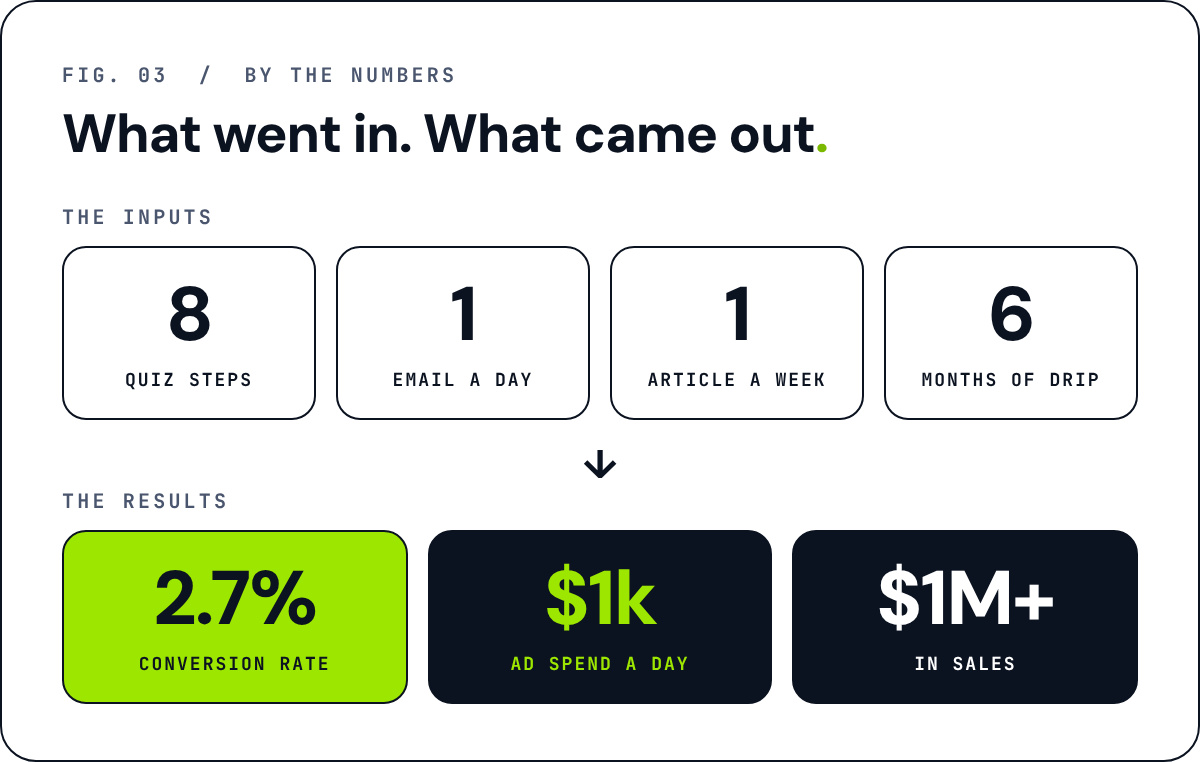
Ad spend multiplies whatever your store already does. At 0.25%, $1,000 of traffic buys a handful of orders. At 2.7%, the same $1,000 buys more than ten times as many. That lift is what let us scale 123 Baby Box to $1k a day in ad spend on the way to $1M+ in sales. You can read the full story in the 123 Baby Box case study.
This is why conversion rate optimization is the first thing we fix in any ecommerce marketing engagement, before we touch budgets. It is also the first thing we check before a seasonal push, which is why it opens our Black Friday marketing strategy.
Want us to find the leaks in your store? Book a free strategy session.
The five steps work as layers of one funnel. The home page earns attention, the copy earns trust, the quiz earns the email, the drip earns the sale, and remarketing brings people back.
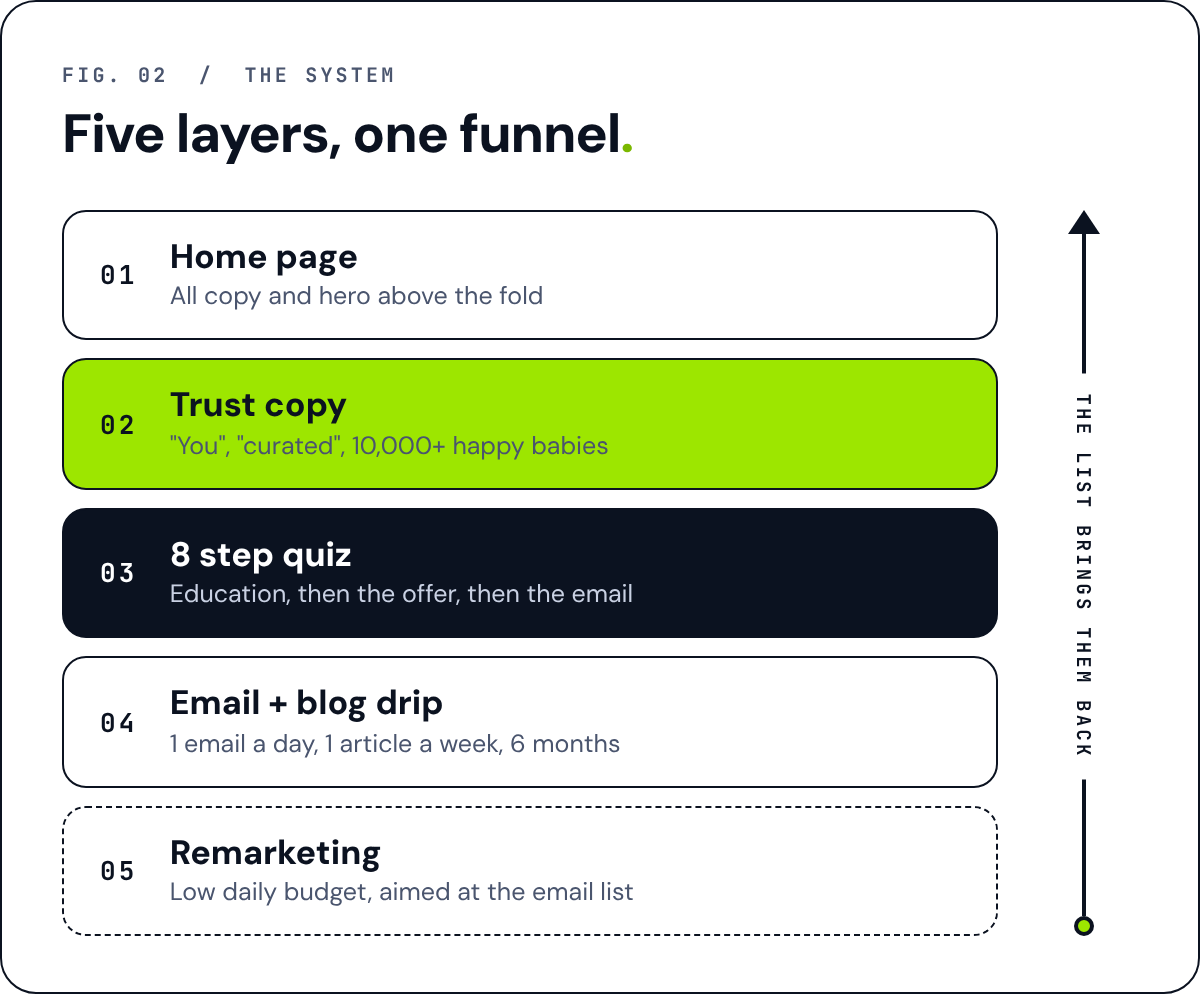
We rebuilt the home page so all of the key copy and the hero sit above the fold. A visitor should know what the product is, who it is for, and what to do next without scrolling. If your current page makes people hunt for the offer, start here. Our ecommerce creatives team builds the hero and supporting visuals for pages like this.
The new copy uses words like "you" and "curated" so it is about the customer, not the company. Then we put heavy trust above the fold, like "10,000+ happy babies." Social proof placed next to the first call to action does more than proof buried in a reviews section. For more examples, see our client results.
Instead of showing price up front, we built an 8 step quiz that educates the customer as they go. It closes with an offer, like 50% off month 1 with a free baby toy, and captures the email at the end. A cold visitor who sees a price has one decision to make: buy or leave. A visitor who takes a quiz learns why the product fits them, and you keep a way to reach them if they are not ready today.
Want a quiz funnel like this built for your store? See how our CRO service works.
Most people who take the quiz do not buy that day. So we send one email a day and publish a new blog article every week, then drip that content to the list for the next 6 months. The weekly articles do double duty: they feed the email calendar and they build organic traffic through search engine optimization.
The last layer is remarketing ads aimed at the people who gave you their email. They already know the brand, so a low daily budget is enough to stay in front of them. It is where our paid advertising team starts before scaling cold audiences. If your ads bring in traffic that never buys, the problem may be the signal you send back to the platform, which we cover in offline conversion tracking.
Divide orders by sessions and multiply by 100. Use the same date range for both numbers, and check it by device, since mobile and desktop usually convert at different rates.
Start with the home page and the offer. Moving the offer, the proof and the call to action above the fold is the change the most visitors will see, so it is the first step in our process.
It did for 123 Baby Box. Replacing the price with an 8 step quiz gave visitors education before the offer and captured an email from people who were not ready to buy, which the daily email follow up then converted over time.
Improve conversion rate first. Every extra visitor you buy converts at your current rate, so raising the rate makes all of your existing and future traffic worth more.
If you want the full playbook behind this, including the unit economics and the 90 day rollout, grab The Ecommerce Bible or read the 90 day plan we use to get ecommerce brands to 500+ orders a month.
Want this built for your store? Book a free strategy session and we will walk through your home page, your offer and your follow up on the call.
Book a free 15-minute strategy session. We will map this playbook to your numbers and tell you exactly what to do first.
About the author
Christian Velitchkov
Founder, Twiz
Book a free 15-minute strategy session and we will map this playbook to your business, with numbers, on the call.
Book My Free Strategy Session(Free 15-minute marketing growth session)🏆 400+ brands grown. $100M+ in sales driven for clients.

