Click the button below and we will turn this article into a plan for your business, with numbers, on a free 15-minute call.
Book a Free Strategy Session(Free 15-minute session with the Twiz team)Written by
Published
November 16, 2026
Reviewed by
Read time
12
A Black Friday marketing strategy that works is not a one week sale. It is a six week system that starts in October with a Google Trends search and ends at Christmas with a free gift in every box. This is the exact 12 step plan we ran for a sleep brand. It pushed Black Friday conversion rate above 2%, took daily sales from $60k to $110k, and added $1.5M in revenue over the season.
This guide walks through every step in order: when to start, what to test, how to keep your list engaged all month, how much to scale ad budgets, and the numbers we hold each stage to. If you sell physical products online and you want a Black Friday ecommerce strategy you can copy, start here.
Most brands plan Black Friday backward from the date. They pick a discount, build one campaign, and turn the budget up on Thanksgiving. Then three things go wrong at once. The ad account has no fresh data, so Meta and Google spend the first few days learning instead of selling. The creative is new and untested, so half of it fails. And the email list has not heard from the brand in weeks, so open rates are low exactly when they matter most.
The brands that win Black Friday are the ones that show up with winning products already identified, winning creative already proven, and an audience that is already in the habit of opening and buying. Everything below is built to get you to that position before the peak week starts.
Want this plan run for your brand? Book a free strategy session.
Open Google Trends and search "Black Friday" plus your category, for example "Black Friday mattresses." Look at the past three years. You will see the week the search line starts climbing, and it is almost never Black Friday week itself. For most categories the climb starts in the first or second week of November. That is your start date. Plan around the surge, not the calendar.
Do not put the whole site on sale in early November. Pick a handful of products with good sales history that are not your top two sellers. Save the best sellers for peak week. Early Black Friday is a test, and the goal is to learn which product and which offer the market responds to before you spend real money.
Create a dedicated early Black Friday collection and point Google Shopping and Meta dynamic product ads at it, plus a few early Black Friday static ads. Give these campaigns their own budget and their own naming so you can read the results cleanly. This is where good paid advertising structure pays off, because clean data in week one is what lets you scale with confidence in week four.
For the early sale, run about five times your normal daily budget. Use mostly image ads and AI generated video to test. This is cheap, fast creative built to find signal, not to win awards. You are buying information about what sells, and five times budget buys that information fast.
Once you have a week of data, find the winning products and offers. Then brief creators to turn around UGC style videos with a new promotion built around those products. UGC Black Friday videos are the single most important creative of the season, and this is the week to commission them. Our ecommerce creatives team works from this same seven day test cycle.
A new deal every day keeps your audiences and your email subscribers on the hook. It also keeps your sending reputation healthy, because people who open daily do not flag you as spam. Most importantly, it keeps the 95% of your list who have not bought yet opening, engaged, and primed to act when the big offer lands. Brands that go quiet in early November and then send five emails on Black Friday land in the promotions tab or worse.
Flash sales should be short. One to two hours drives impulse purchases in a way a weekend sale never does. Gate them for VIPs and existing customers, make them steeper than your public offers, and use them to clear inventory you do not want to carry into December. SMS is the right channel because the window is too short for email open patterns.
Send a good share of your traffic to a page with a visible countdown. It creates urgency and keeps you compliant, because you swap a new product into the flash sale each time rather than running one fake deadline all month. Early Black Friday products can go straight into a flash sale slot once their test is done.
Want help building your November email and SMS calendar? See how our ecommerce marketing team works.
You need new imagery for BFCM week. Take the concepts that won in early Black Friday, make 25 variations in the same style, and apply them to your absolute best sellers. You cannot discount much further than you did in early November, but you can change the presentation, the bundle, and the urgency. New creative on proven products is how you keep performance from fading through the week.
Once the discounts have peaked, the offer needs something new to keep feeling fresh. A free gift with every order does that. Put a badge on every collection card and every product image card so it is visible everywhere a shopper looks, and carry it through December so the momentum does not stop on Cyber Monday.
By now you have more engaged audiences, more proven products, and far more conversion data for Meta and Google than a brand that showed up on Thanksgiving. That is what lets you spend 25 to 30 times your normal budget and still convert. Two rules keep the account healthy at that scale: plan for 10 to 20 ads per $10k a month in spend, and never run fewer than five ads per campaign. The algorithm needs options to keep finding buyers at volume.
For the sleep brand, conversion rate during Black Friday went above 2%. Daily sales rose from $60k a day to an average of $110k a day across the period. The total was $1.5M in added revenue. Those are the numbers to compare against: conversion rate above 2%, daily revenue roughly doubled, and a season that builds rather than spikes.
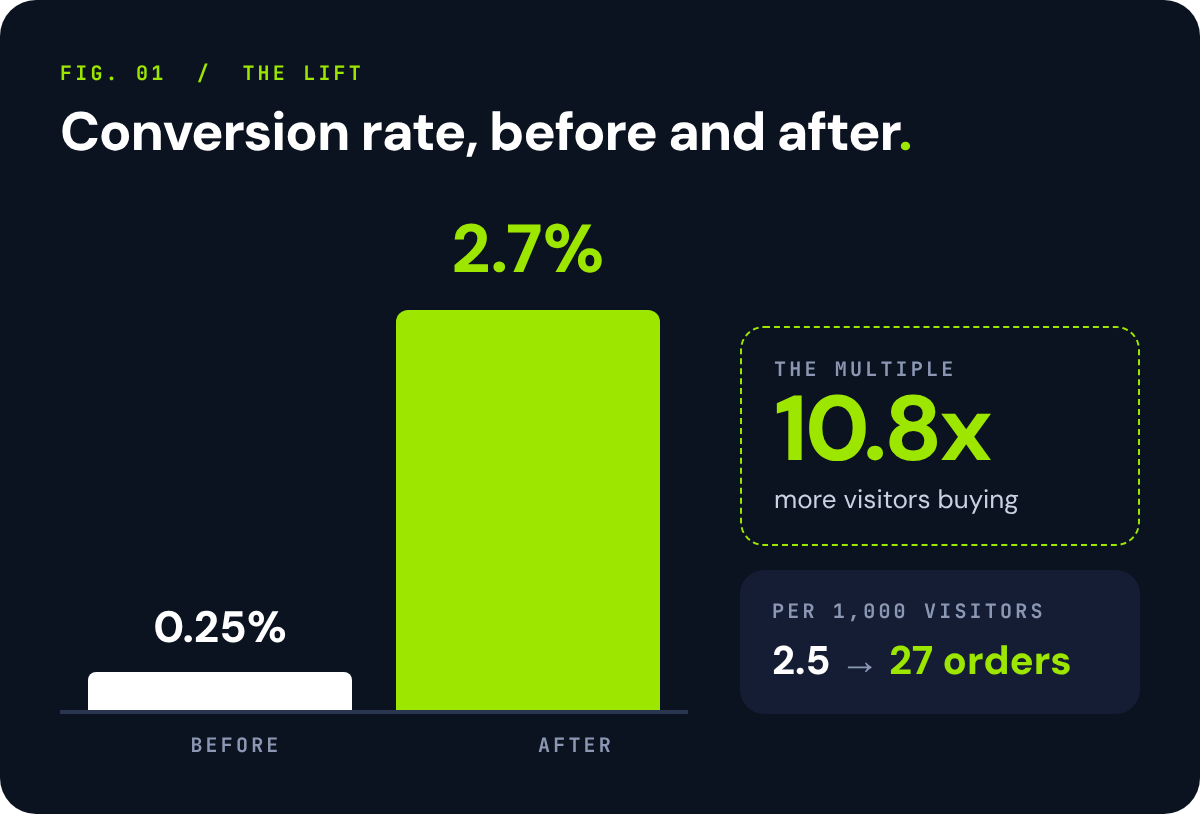
Every step above is designed to push conversion rate up before the budget goes up, because ad spend only multiplies what the site already does. A store converting at 1% needs twice the traffic of a store converting at 2% to make the same sales. If your conversion rate is below 2% going into November, read how to improve your ecommerce conversion rate first. The 123 Baby Box work in that article took a store from 0.25% to 2.7%, and the same five steps apply before any Black Friday push.
Start testing in the first week of November at the latest, and start planning in mid October. Google Trends for your category will show the exact week search interest begins to climb, and that is when your early sale should be live.
About 5x normal for the early November test, then 25 to 30x normal for peak week, provided you have winning products and creative proven in the test phase. Scaling to 30x without that data is how brands lose money on Black Friday.
Plan for 10 to 20 ads per $10k a month in spend and never fewer than five ads per campaign. Seven days before Black Friday, launch 25 new variations on your best sellers.
No. Test with products that have good sales history but are not your top two sellers. Save the best sellers for peak week so the biggest offer lands on the products most people already want.
Above 2% is the benchmark we hold ecommerce brands to during Black Friday week. The sleep brand in this case study crossed 2% while doubling daily revenue.
The full playbook, including the creative volume math and the retention calendar that carries momentum into Q1, is in The Ecommerce Bible. For the longer runway, read the 90 day plan we use to get ecommerce brands to 500+ orders a month, and see more results on our client results page.
Want us to map your Trends window, pick your test products, and build the creative and budget plan? Book a free strategy session.
Book a free 15-minute strategy session. We will map this playbook to your numbers and tell you exactly what to do first.
About the author
Christian Velitchkov
Founder, Twiz
Book a free 15-minute strategy session and we will map this playbook to your business, with numbers, on the call.
Book My Free Strategy Session(Free 15-minute marketing growth session)🏆 400+ brands grown. $100M+ in sales driven for clients.